
Travelling With Your Rabbit
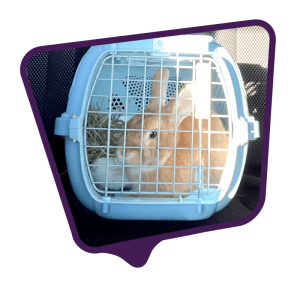
Rabbits, for the most part, are homebodies. They thrive in a stable environment with a steady routine. For many rabbits, travel is necessary, whether it be a trip to the vet or a move to a different city. Most rabbits will not enjoy the experience – but with time, patience, and practice, you can acclimatize your bun to travel and thus reduce his stress levels significantly.
Car Travel
Start by making sure the bun’s carrier is suitable. This means roomy enough for the bun to loaf comfortably, but not so spacious that your bun can slide around too much when you break for a red light. A soft blanket or towel in the carrier will make it less slippery and help absorb any accidents if they urinate in it. Somethings to consider; Can you get your bun in and out fairly easily? Can you run a seatbelt through the top handle to secure the carrier? Will the latches or screws hold the carrier together, or do you need to ziptie the corners for added safety?
Now that you have your carrier, let your bunny explore it when they don’t need to go in it for travelling. You can leave it out and open for them to explore. You can place a few pellets or treats in there for them, and even pet them while inside. This will help them associate the carrier with enjoyable experiences.
If you are going to be travelling with your rabbit on a longer trip (not just to the vet) you can practise having them in it. You can do some short walking trips. around the house, return, let the bun out. Repeat over time until your bunny is more comfortable with being in the carrier. Positive associations, like treats and pats can help.
Next step is having them in the carrier in the car. Keep the first car ride short. We recommend having the radio off and talking to your bun. The sound of your voice will help comfort them. You can strap the bun’s carrier either in the seat beside you or in the middle back seat so your bun can see you. Knowing your cars airbag information will help you decide what seat to place them in.
Increase the frequency and length of car rides as necessary. Hopefully in time, your bunny will most likely go from hunched and nervous and refusing to eat/drink during car rides, to more relaxed and willing to nibble on hay or snacks.
If you are taking your bun on a longer or cross-country car trip, it’s important to budget time for frequent stops to check on your bun (once every few hours is recommended). If you find a suitable place to stop and rest, portable pop-up pens are great for giving your bunny a safe space in which to stretch and move around, use the litterbox, and eat/drink. They also come in handy if for overnights in a hotel along the way. Just make sure to pack a little lunch bag with your bun’s favourite fresh greens and wet them thoroughly prior to feeding to reduce the risk of dehydration.
You can talk to your vet about using Pet Rescue Remedy for the trip as well.
Airplane Travel
Many airlines have stopped allowing rabbits in the cabin. If you are looking to fly with your rabbit, make sure your vet clears them as healthy to fly.
If you are able to find an airline that accepts bunnies in the cabin, make sure you use a carrier that meets that airline’s requirements to the letter – don’t just believe the “airline approved” sticker. Ensure that “pet” appears on your reservation.
If you are flying internationally with your rabbit, it can be more complicated. The limited airlines that allow rabbits in cabin for international flights often have flights operated by alliance partner airlines that do not. It is the operating airline’s policies that apply, not the booking airline’s. For example if Iceland Air allows rabbits in cabin – if the Iceland Air flight from the Middle East is operated by British Airways, which doesn’t allow rabbits on their planes at all, your bunny wont be allowed to fly with your Iceland Air ticket.
In some cases you may be able to hire a professional pet shipper. Do your research on them, ask questions, request references and ensure you are comfortable with them. It may be necessary if your bunny will be flying on a different flight or airline than you. We have used Bunnies on Board several times and they have been excellent.
You will need to find out if your destination country will accept rabbits. Most will have conditions, and some will not.
You will need an import permit from your destination country, and this will need to be shown to the airlines. Find out what the requirements for the importation of rabbits are as well as what the permit application procedure is. Import permits are usually good for a few months.
Before your trip (usually 10 days before the actual flight) you will also need to obtain an export permit from the country you are currently in. This involves a visit to your bunny’s vet for paperwork (often referred to as a pet passport) and it may also require a visit to a government vet for another document saying that your bunny can leave the country. Depending on where you are and where you’re going, your bun may need to be microchipped, or vaccinated, or examined to ensure he’s fit for travel, Prepare for the possibility of a mandatory quarantine. A number of countries allow the quarantine to be done in your destination home (subject to certain conditions) rather than in an impersonal animal quarantine facility. If you have that option, the authorities involved will give you a list of requirements that must be met and will then check in person that all is ready to their satisfaction prior to the arrival of the bun.
For the actual trip, you will need to get a travel crate that meets IATA requirements – this is the international organization that makes the rules all airlines must follow. IATA clearly states in their regulations that you can use a hard plastic dog crate (like a Sky Kennel) as long as it’s modified a little bit. Get one big enough to allow your bunny stretch out because he will not be let out for exercise like dogs and horses are. Make sure you replace the plastic and metal screws with all-metal ones (compatible hardware is readily available on Amazon) and have someone handy with tools cover the openings all around the kennel with metal mesh (pliable insect screen or hardware cloth should do the trick). This is so that your bun doesn’t injure any handlers during transit.
You will need to attach a plastic bag with copies of your bunny’s travel documents (keep hard and soft copies for yourself and the airline too), as well as your bun’s name, the airline name, the destination country, your mobile phone number, etc. to the top of the crate. A refillable-from-the-outside plastic water bowl will need to be secured to the inside of the door, and fresh veg or pellets in a plastic bag attached to the crate handle. Inside the crate, you can place a couple of layers of pee pads (masking tape loops on the underside will help them stay put) and a very thick bed of hay, as well as any veg that will travel well and offer hydration. No toys are allowed, for safety reasons, but if you can sleep with a small fleece on your pillow for a few days before flying, and then put that in the crate, your scent will comfort your bunny. Finally, you will need to ziptie the crate corners and the door after you’ve gone through security – use quick-release plastic zip ties, not the kind that must be cut
IATA allows two bunnies in one crate, but the buns must weigh less than 14kg each and be roughly the same size. For unusual situations, contact the IATA for advice.
It’s worth noting that this entire process will be much, much simpler if you and your bunny are coming from the USA to Canada, or going from one EU country to another (or from any country that shares a treaty and a border with another country).