
Eastern Cottontails
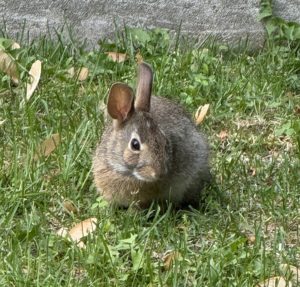
Rabbit Rescue receives numerous inquiries regarding wild rabbits (Easter Cottontails) especially in the spring. Cottontails are not the same as domestic house rabbits – even their genetics are different!
What should you do if you find a baby cottontail? Many people who find baby rabbits outside, do not see the mom and automatically assume that they have been abandoned. Usually this is not the case. An absent mother is normal! As rabbits are crepuscular (most active at dusk and dawn), the mom usually comes around late at night to nurse and feed her babies. The milk is very rich, and, unlike kittens who need to eat every 3-4 hours, bunnies only nurse for a few minutes each day; usually once in the early morning, and then once at night. Their preferred nursing time is between midnight and 5 am. Average nursing time is only 5 minutes.
If you suspect a rabbit has abandoned her nest, at dusk, take two sticks or string and cross them in an X over the nest. If they are disturbed in the morning, the mother has likely returned. If you find a nest that has been destroyed, you can move it or rebuild it to a safer place within 10 feet of its original location. By removing baby bunnies from a nest, when there is in fact a mother rabbit around for them, it greatly reduces their chances of survival. Over 90% of cottontails will die if an individual takes to raise it (usually of fright, or improper feeding – overfeeding, underfeeding, or bloat).
Wild rabbits are weaned at 3-4 weeks of age. By 100 grams they are on their own (and can be released by wildlife rehab centres if in captivity). If they are not injured or orphaned, the best thing you can do for them is to leave them alone!
WARNING: Cottontails are wild animals. Not only will they never be happy kept in captivity, but they are a provincially protected species in Ontario. It is illegal to keep them.
Who to Call?
If you find an injured or orphaned wild rabbit, or other animal, call the Toronto Wildlife Centre: 416-631-0662 or the OSPCA Wildlife Rehabilitation Centre: 705-534-4350. Many wildlife centres will allow you to participate in the release of an animal you brought to them when they are ready to go. It’s a very rewarding experience! If you’re outside the area check out this website to find your nearest wildlife rehabilitator: http://www.ontariowildliferescue.ca/
Cottontail Rehabbers in Ontario
https://www.ontario.ca/page/find-wildlife-rehabilitator
https://www.ontariowildliferescue.ca
Below is a list of some Cottontail Rehabbers in Ontario
Southern Ontario:
Toronto Wildlife Centre, Toronto, www.torontowildlifecentre.com, 416-631-0662
Volunteer Wildlife Network, Stittsville (near Ottawa), Selena Walker, (home based rehab) H) 613-831-8105, W) 613-722-6521 x 6657
Hobbistee Wildlife Refuge Nanticoke, Ontario, 519-587-2980, https://www.hobbitstee.com
Procyon Wildlife, 905-729-0033 https://www.procyonwildlife.com/
Another Chance Wildlife Rehabilitation 519 868-1937, St. Thomas https://anotherchancewildlife.ca/
Salthaven 519 264-2440, Mount Brydges, https://www.salthaven.org/
Urban Wildlife Care, 905 818-5708, Grimsby, https://www.urbanwildlifecare.com/
Wildlife Haven, Waterloo, 519 590-3676, https://wildlifehavenwaterloo.ca/
Woodland Acres Rescue, Brampton, 647 858-3194 https://www.facebook.com/profile.php?id=100064682350097&ref=page_internal
National Wildlife Centre, 416 577-4372, Caledon East https://www.nationalwildlifecentre.ca/
Shades of Hope Wildlife Refuge, Pefferlaw, 705-437-4654 https://www.shadesofhope.ca/
Foster Forest Wildlife Orphanage, Trenton, https://www.facebook.com/FosterForestWildlifeOrphanage/
Woodlands Wildlife Sanctuary, Minden Hills, https://www.woodlandswildlifesanctuary.ca/
Aspen Valley Wildlife Sanctuary, Rosseau, 705-644-4122, https://www.aspenvalley.ca/
Ottawa area
My Wildlife Rescue: www.mywildliferescue.org. Email: mywildliferescue@gmail.com.
Rideau Valley Wildlife Sanctuary, Ottawa County (North Gower): www.rideauwildlife.org. Phone: 613-258-9480. Email: rideauwildlife@ripnet.com.
Sandy Pines Wildllife Centre, Napanee: https://sandypineswildlife.org. Phone: 613-354-0264.
Further Reading
https://www.torontowildlifecentre.com/wildlife-emergency-rescue-hotline/how-to-help-orphaned-baby-wild-animals/how-to-help-orphaned-baby-rabbits/
https://www.torontowildlifecentre.com/wildlife-emergency-rescue-hotline/conflicts-with-wildlife/common-rabbit-problems/rabbits-nesting-in-yard
http://www.nhptv.org/Natureworks/easterncottontail.htm
http://www.rabbit.org/care/orphan.html
Wild Vs. Domestic Rabbits
Respecting or neglecting the unique environmental, dietary and psychological needs of a domesticated rabbit versus a wild rabbit can mean life or death (or at the least, quality and/or quantity of life) for that individual rabbit. Domesticated rabbits can be provided with long, enriched lives as companions inside our homes, whereas wild rabbits are equipped to live outside and have not gone through the domestication process.
Domestication, is the process of generations of selective breeding creating a dependency on humans and takes away that species’ ability to survive independently outside. Both domestic and wild rabbits are prey species which means that reading their stress levels, health condition, behaviour and ultimately their ongoing quality of life can be difficult to assess by the untrained eye. Yet the behaviour and interaction between wild rabbits and humans versus domestic rabbits and humans can be drastically different and obvious in normal situations. Domestics have the ability to interact with their trusted humans to the same degrees as the relationships and interactions we have with our companion cats and dogs. This would not be a typical encounter with a wild rabbit.
Wild rabbits requiring medical or behavioural assessments and treatment, including babies once they are confirmed to be orphaned, can receive the necessary help through licensed wildlife rehabilitators. Ontario’s Ministry of Natural Resources and Forestry regulates these rehabilitators and the goal is to return native species to a natural life in the wild once recovered and/or old enough.
The first step in helping a rabbit in need is understanding how to tell domestics apart from wild rabbits – generally by their appearance and not always behaviour. Domestic rabbits can sometimes escape from a home or outdoor enclosures (not recommended!) but often, are abandoned outside by humans. Just because they are found outside, does NOT mean they are a wild species. And just because you take a wild rabbit inside, this does not magically turn them into a domesticated species. There are what seem like an endless number of domestic animals, including rabbits, requiring homes. These amazing companions don’t have the option of living outside whereas healthy wildlife thrive outside of captivity. Wild rabbits do poorly indoors, they never adapt, it is illegal for most vets to treat them, and it is also illegal to house them without a wildlife permit.
Scientific classification (Taxonomy)
Rabbits, hares and pikas are small mammals in the family Leporidae of the order Lagomorpha. To begin understanding the difference between domesticated rabbits and their wild counterparts, it can be helpful to look at how they are further divided into different classifications, specifically their genus and species.
While The American Rabbit Breeders Association Inc. currently recognizes 49 standard domestic rabbit breeds, there are at least 305 breeds of domestic rabbits in 70 countries around the world. A “breed” refers to the different varieties of domestic animals of the same species. Here in southern Ontario (south of the northernmost point of Lake Superior) the more commonly found native wild rabbit species living near people is the Eastern cottontail. Snowshoe hares and European hares (the later being native to Europe but introduced to Ontario as game animals/for hunting) can also be found in this region. So, there are literally hundreds of different domestic rabbits that can be found and only one common wild species in the more urban areas of this region.


Fur Colours, Length & Markings
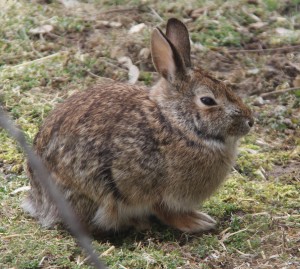
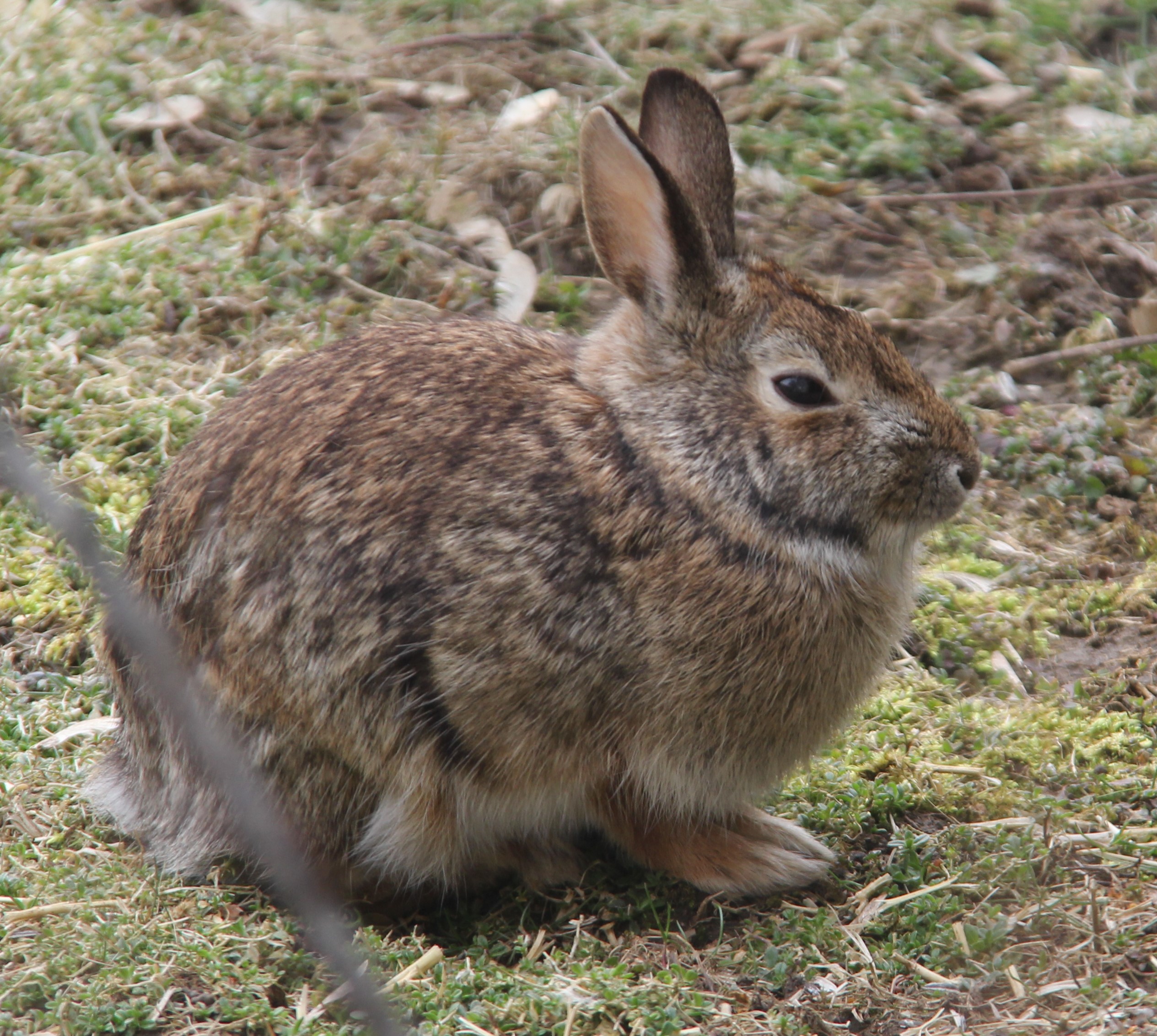
Rabbits can vary greatly in colouring, but it is only the domesticated rabbit that can found in solid colours (and mixes) including: black, year-round white, grey, brown, orange, red etc. As well, it is only domestics that will be found with very distinct fur patterns such as spots and lines. Their wild counterparts in southern Ontario, the Eastern cottontail and European hare, will always be and speckled or peppered brownish-red over entire top of body (which more specifically is a mix of small specks of brown, white, orange/red, grey and black throughout most of their body) with the purpose of being able to easily camouflage into an outdoor environment. The third type of wild species of rabbit found in southern Ontario is the Snowshoe hare who also comes in the same kind of even brown over entire top of body, with their fur colouring changing to white to camouflage better during colder months in snow. It is true that some domesticated (companion animal) rabbits can come in almost this exact same speckled brown colouring – which is when it can be most confusing to tell them apart.
Some domestic rabbits can have longer or more decorative fur such as angoras or lionheads whereas a wild rabbit’s fur will be more uniform (and shorter than the fancy domestic breeds) throughout their entire body and is a lot more utilitarian. In cold weather, the Easter Cottontail can appear to have fluffier fur. The fur of a domestic can look a lot fluffier or softer than the fur of an adult cottontail which will appear coarser and sleeker. Baby wild rabbits are typically found with a little white patch of fur on their foreheads, although some domestics can be found with a similar obvious spot.
Size & Ear Positioning
The size or weight of domestic rabbits can vary drastically, with some (the Flemish giant) reaching upwards of 22 pounds and measuring about 4 feet long. Adult Eastern cottontails are about 15-18 inches long and weigh between 2 and 3 pounds on average. If the rabbit has ears hanging down, as in a lop-eared rabbit, it is domestic.
Warrens & Nests
Domestic rabbits trying to cope outside will dig down into the earth to have their babies in warrens (or deep underground holes and tunnels), similar to the wild European rabbits. Eastern cottontail mothers instead create a very shallow depression in the ground where barely furred and eyes closed babies lay at ground level but covered by bits of their mother’s fur and grass. Snowshoe and European hare babies are born fully furred with their eyes open in a protected area of brush or grass and have very different life stages than Eastern cottontail babies.
Behaviour
Often, appearance over behaviour is used to determine the difference between the two. A timid, scared or cautious domestic rabbit found outside can sometimes act very similar to a wild species. Both domestic and wild rabbits can be equally difficult to catch or just as easy, depending on the circumstances. A wild rabbit that appears friendly or is easy to contain, may be suffering from a life-threatening illness or injury. A domestic rabbit that can be extremely difficult to catch is not necessarily coping very well in other aspects. Eastern cottontails will often nest in backyards or schools, even directly outside of homes that have pet dogs that frequent the yard. A common and serious problem occurs when very young Eastern cottontail babies are taken into captivity at an early age and can suffer short and long term from habituation and sometimes irreversible damage from imprinting. If a baby Eastern cottontail found outside of the nest is not able to escape predators (including humans) this could be an indicator that something is wrong. For more info on what do if you suspect an orphaned cottontail, click HERE.
Allowing for each of these species, whether domestic or wild, to live natural and fulfilling lives in their respective environments with the right kind of attention, leads to happier rabbits and better outcomes for all.
If you suspect an injured WILD rabbit, please contact a wildlife rehabilitator. For a list of ones in Ontario, click HERE.
If you are unsure if a rabbit you have seen outdoors is wild or domestic, snap a pic and send it to us.
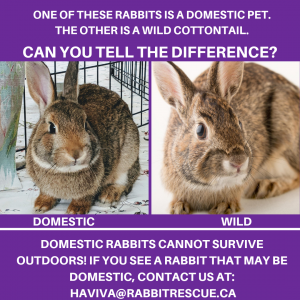
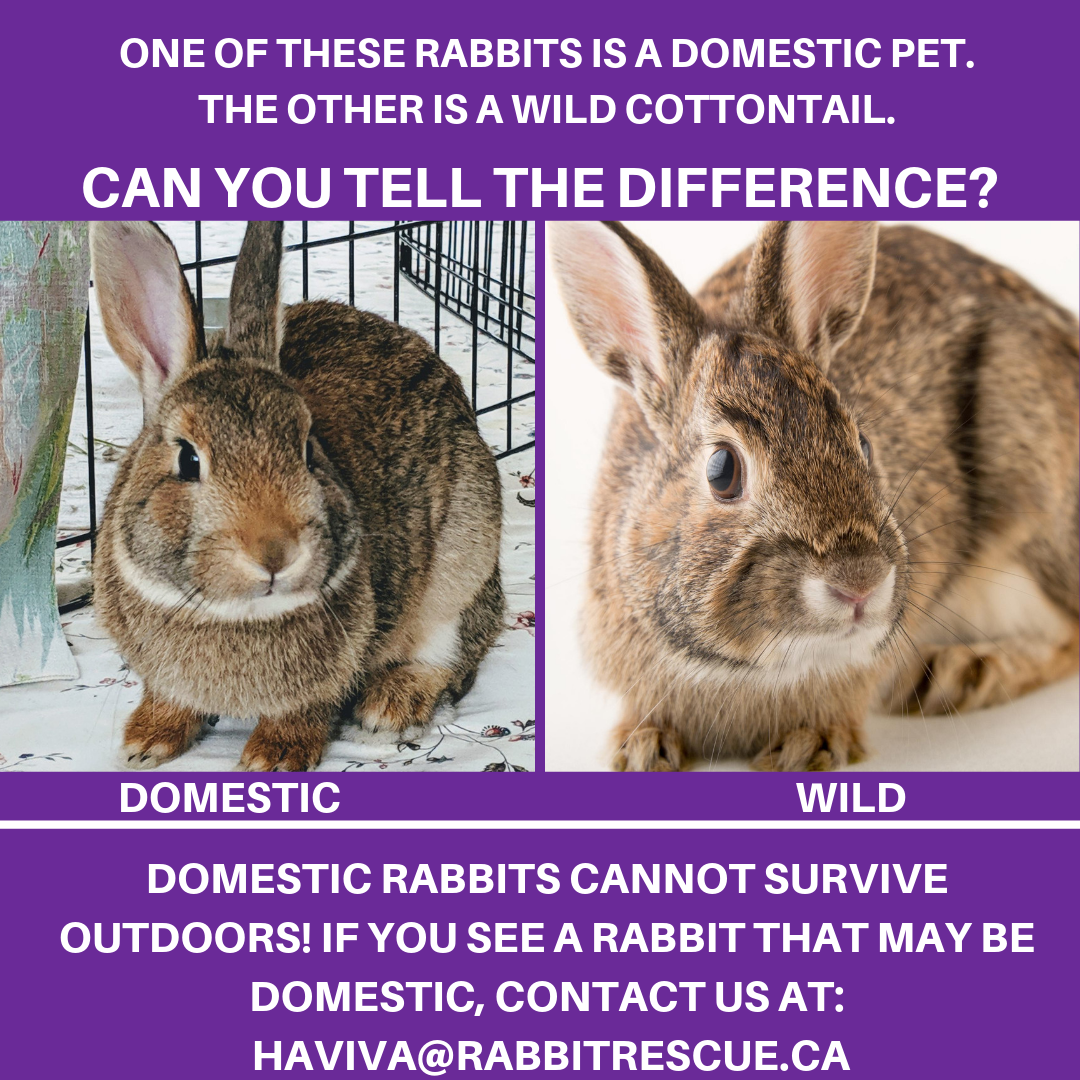
Were you able to determine which is wild and which is domestic? The rabbit on the left is domestic. His name is London and he was saved by RR volunteers after being dumped outside. The rabbit on the right is an Eastern Cottontail.